
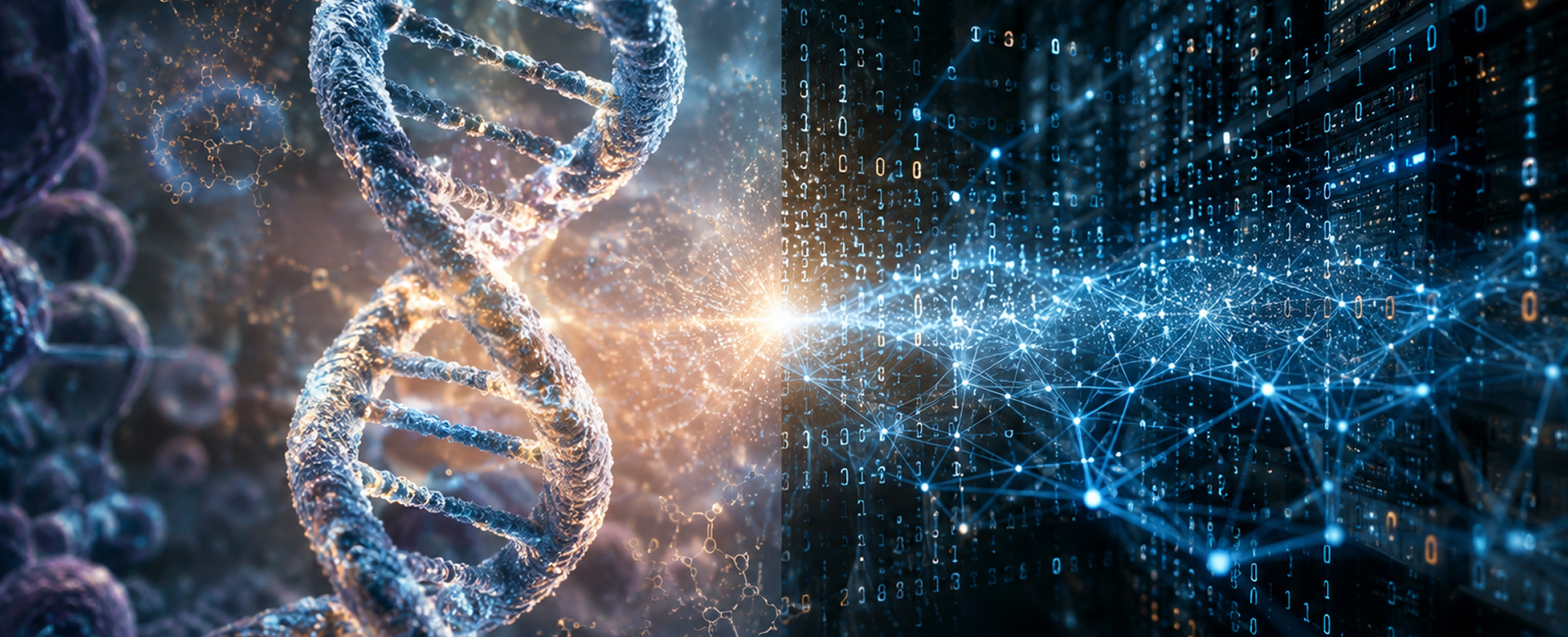
What do a human genome and an artificial intelligence model have in common?
At first glance, almost nothing. DNA is made of four chemical letters—A, T, G, and C—while a large language model is built from vast arrays of numerical weights. One helped create every living person on Earth; the other can write poems, solve problems, and help imagine unfamiliar futures.
Yet both may be versions of the same remarkable idea: information waiting to be read.
DNA does not build an eye, a hand, or a brain by itself. Its instructions become meaningful only when the machinery of a living cell reads, copies, and translates them into action. In much the same way, the weights inside an AI model are only numbers until a prompt activates them. The model’s apparent knowledge does not sit neatly stored like sentences in a library. It emerges through a process—layer by layer, calculation by calculation.
Both genomes and AI models are also records of enormous searches.
A genome is the surviving result of nearly four billion years of evolution: countless variations tested against a changing world, with useful patterns preserved through reproduction. An AI model is shaped through repeated correction, learning statistical patterns from immense quantities of human-created text. Neither is a perfect record of what came before. Both are compressed remnants of experience.
That resemblance has a distinctly science-fictional power.
We are beginning to understand that intelligence may not always look like a person thinking in a room. It may be distributed, encoded, indirect, and partly mysterious—even to those who create it. Biology still cannot explain the purpose of every section of the human genome. AI researchers can inspect every model parameter and still struggle to identify precisely where a concept, memory, or behaviour resides.
Perhaps that uncertainty is not a failure of understanding. Perhaps it is a clue.
From evolution to human brains to artificial minds, the universe appears to keep discovering new ways to store experience, test possibilities, and learn from what survives. Science fiction has long asked whether humanity might create a new form of intelligence.
The more intriguing question may be whether intelligence has always been the universe’s way of learning about itself.