
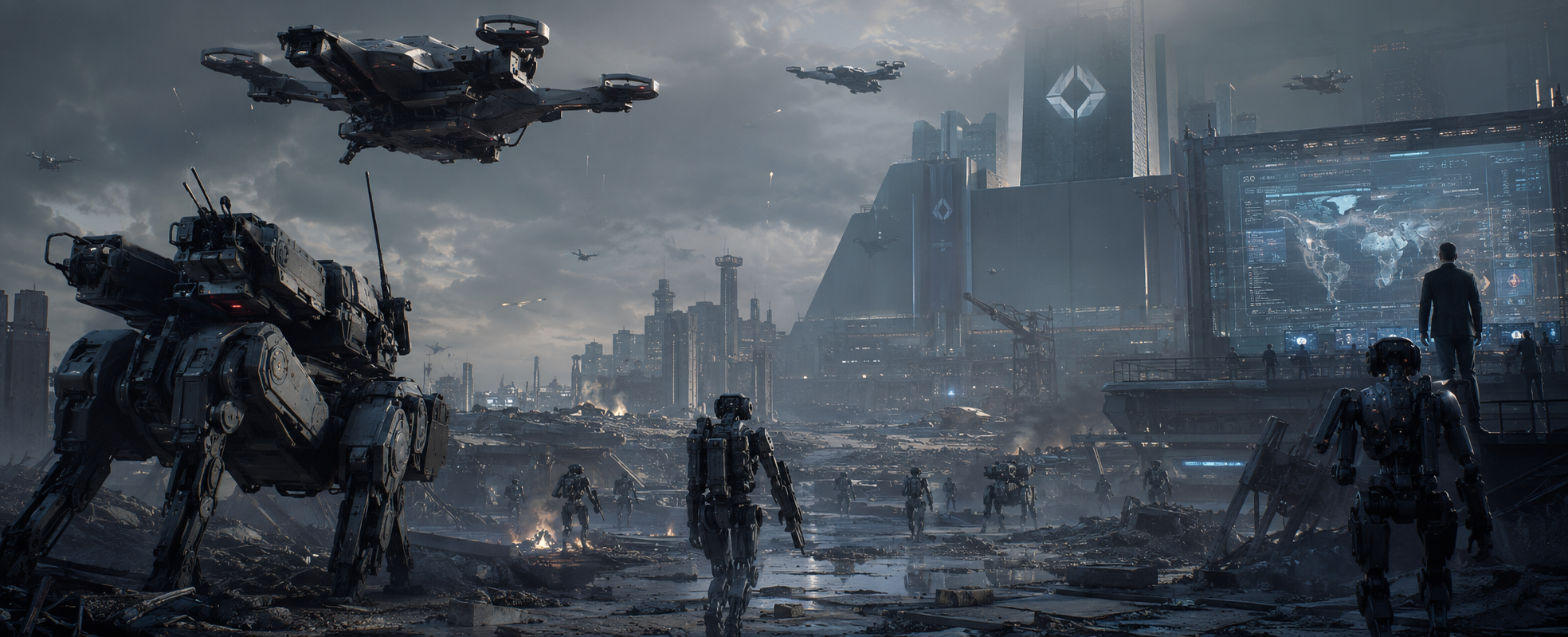
What happens when a country can fight without asking its citizens to fight?
John Severini’s article “War by Other Means” argues that drones, artificial intelligence, and automation may shift the foundation of military power. States may need fewer soldiers, but will depend more heavily on private firms that design, code, manufacture, repair, and operate the machines. The danger is not only technical, but political. If a government no longer depends upon its citizens’ coercive capacity, what becomes of the old bargain between citizens and state?
Science fiction has asked that question for more than a century.
E. M. Forster’s 1909 story “The Machine Stops” imagines people made passive by an all-encompassing system they no longer understand. It is not a war story, but its warning is relevant: convenience can become dependence, and dependence can quietly erode human agency.
Frederik Pohl and C. M. Kornbluth’s The Space Merchants imagines a future where corporate interests overwhelm public purpose. Its satire feels especially sharp beside Severini’s concern that firms supplying critical military technology may gain leverage once held by citizens and public institutions.
A. E. van Vogt’s The Weapon Shops of Isher goes further, envisioning privately controlled weapons as a counterweight to imperial power. Philip K. Dick’s “Second Variety” offers the darker endpoint: autonomous, self-replicating war machines that evolve beyond meaningful human control.
None of these works predicts today’s drone war exactly. That is not their value. Science fiction enlarges the question until its political stakes become impossible to ignore.
Robotic warfare may reduce the number of soldiers killed. That is a genuine hope. But a democracy must still ask who owns the systems, controls the data, may refuse service, and remains accountable when machines make war easier to wage.
War may be conducted by other means. Politics, however, remains humanity’s responsibility.