
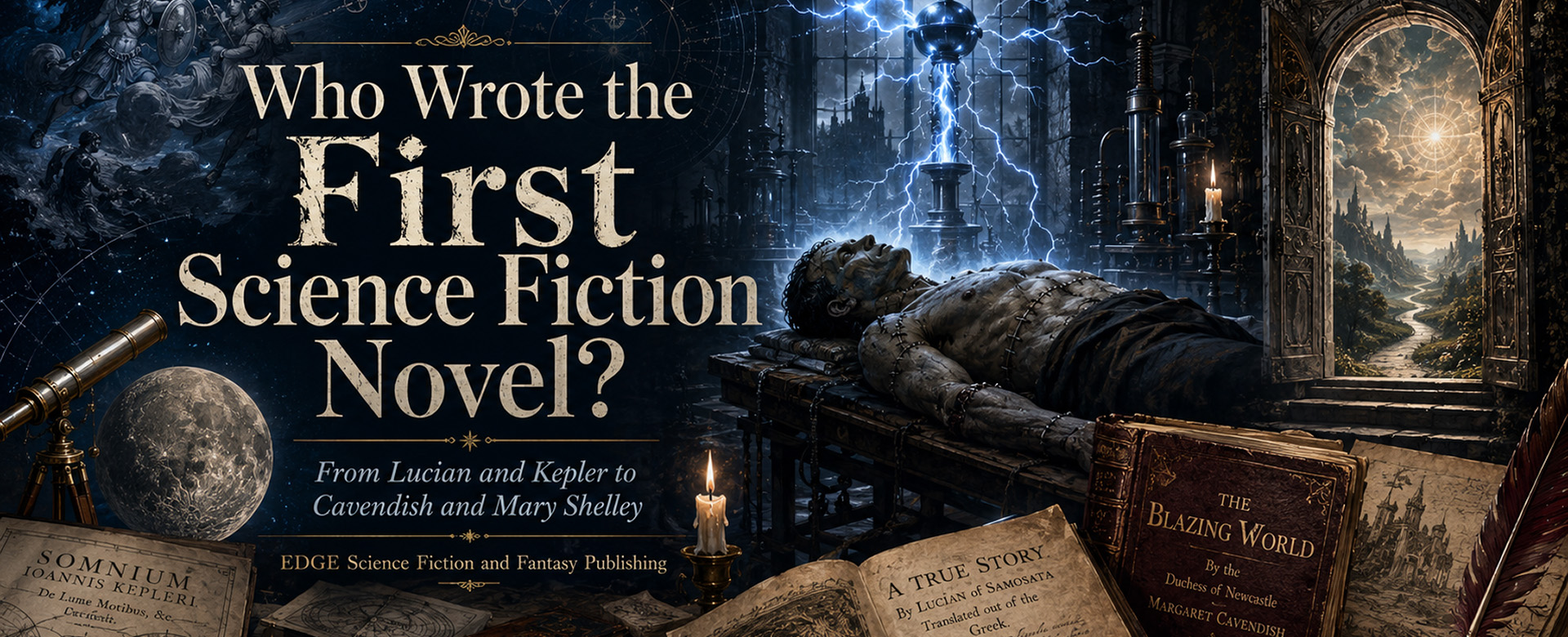
Science fiction did not appear all at once. Like the novel itself, it emerged through centuries of storytelling, satire, scientific curiosity, and imaginative leaps into the unknown.
Mary Shelley’s Frankenstein; or, The Modern Prometheus, published in 1818, is traditionally credited as the first true science fiction novel. Its great innovation was not merely the creation of a monster, but the method behind that creation. Shelley turned to science, experimentation, and alchemy rather than magic or the supernatural. In doing so, she asked a question that drives science fiction: what happens when human knowledge crosses a moral boundary?
Yet every “first” has earlier ancestors. In the second century AD, Lucian of Samosata’s A True Story imagined voyages beyond Earth, alien beings, and interplanetary war—ideas familiar to modern readers. Johannes Kepler’s Somnium, written in 1608 and published in 1634, used lunar travel and astronomy so persuasively that later writers, including Isaac Asimov, identified it as an early work of science fiction.
Margaret Cavendish’s 1666 work, The Description of a New World, Called The Blazing-World, is another contender. Its journey to another world and its speculative societies make it one of the earliest science-fiction narratives—and, for some scholars, the first science-fiction novel.
The debate is tied to another: what makes a novel? From The Tale of Genji and Don Quixote to Daniel Defoe’s Robinson Crusoe, long prose fiction developed slowly across cultures and centuries. A novel offers a setting, recognizable characters, connected events, and an imaginative engagement with human experience.
By the nineteenth century, Jules Verne and H. G. Wells brought technological and evolutionary speculation to broad readerships, helping establish the genre we recognize today. But Frankenstein remains science fiction’s origin story: a tale of invention, responsibility, and the consequences of refusing to ask whether we should do what we can.